Saturday, 28 May 2016

Awesome ideas from #EducampTheTron

Today I joined a bunch of teachers at EducampTheTron.  If you're not familiar with educamps, you can find more info here.

I've been working my way through some of the slides from the SmackDown, (a SmackDown involves people sharing ideas and tools with each other in a short amount of time).  First up, I had a play with a couple of resources Dave Winter suggested.  There was Story Builder, a tool I've played with before but now I have a creative writing group, the Ninja Unicorns in Uniforms, and I think they would have a blast with it.  Here's my quick test.  

I also had a look at Background Burner, which is an online tool that removes backgrounds from images in seconds.  I used a photo without a cluttered background for my test:


Then I transported my Book Fridge to Egypt, using their stock photos.


I'm not sure what I might need this for at the moment, but it will probably percolate in my brain and I'll wake up at 2am with a crazy idea!

There was a slide about Creative Commons which had several sites I knew about and one I didn't - photosforclass.com.  Images are filtered so they are appropriate for school, and when they are downloaded they automatically cite the author and image license terms - awesome!


Moving on, I had a look at Breakout EDU.  Thanks to Kim Tautari-Scott I actually got a chance to play this game today.  It was another idea I'd seen on Twitter, but I couldn't get my head around it until I saw it in action.  I can't say I was very good at it; I imagine I'd be better second time up having got the general gist of it.  It doesn't fit into what I'm doing at the moment so I'll put it aside for now.

Over to a slide about Blendspace.  It is an interesting curation tool that lets you add in images, documents, Youtube clips and quizzes.  It looks great but I have no need for this one yet either.

Alex Le Long provided some great links to genius hour resources - Youtube playlists and a Google Drive folder from the GAFE summit.  I will share these with our Year 5 & 6 teachers as I am sure they will be interested in these.  I also noticed her Slam Poetry playlist and then searched for some done by primary school kids.  

Here is the back story to this - yesterday, Ryan, one of our teachers, came into the library and asked what I thought about students doing slam poetry in our Reading Wonderland.  I said 'awesome, as long as you do it!'.  I had thought about having the students put on short plays in there, because the tiered seating makes it perfect for performances.  But it would have taken a lot of organisation.  So, I'm thrilled that Ryan's going to get that going and now I can suggest some great YouTube clips.  Perhaps my writing group will be interested in trying out writing slam poetry.  Actually, I've just gone back into Blendspace and downloaded a couple of lessons on slam poetry shared by teachers on there.  Some of it is on performance, which I can share with Ryan, and the rest is about how to write them.  Ooh, lots of great things for the Ninja Unicorns in Uniforms on Tuesday!

And...this is how you lose hours online!  It's way past my bedtime and my laptop's battery is dying, which is a sign I should wrap this up.  If you get a chance to attend an educamp I would highly recommend them.  They are free and full of really interesting people and can lead you on new adventures!

Friday, 13 May 2016

Introducing our Reading Wonderland

Last week we opened our new library space and our students got VERY excited!  Here's proof:


A neat feature is the little creatures, hidden doors and adorable bugs that can be found in the room if you look hard enough.  Spotting these was the reason for a lot of the extra noise!  Here's a few of them...


History

For a long time I lamented over the lack of space in our library.  Considering we have 750-800+ students, our 89m2 library was often jam packed.  "It's like a club" was a teacher's comment after venturing in one lunchtime.  

In January 2014, I made a proposal to the Board of Trustees to enclose the library courtyard area.  I was given the go ahead to get some quotes but my happiness was short-lived as incorrect concrete had been laid and therefore walls could not be erected on it.  The cost of digging up the old concrete and then laying new concrete made the project unaffordable.


For some reason this area wasn't very popular!

I considered taking over a bit of our adjoining resource room, but a giant air conditioning unit would have to have been moved.  In the end I looked at enclosing the courtyard with an outdoor screen, much like cafes often have, in order to weatherproof it and be able to lay carpet.  This revised proposal was accepted late last year and all systems were go!

Esther, our library assistant, suggested I put tiered seating in the room and then she found an apprentice builder who could do it for us.  I love the different dynamic this creates in the space.

My vision for the area was to have a theme so that students feel they are in a special spot, quite different from the rest of the library.  I ended up asking our very creative teacher aide, Jenna, to make a meadow/forest mural that went around every wall in the space.  Considering the walls are made of corrugated iron, glass, and wooden slats, I asked Jenna to go with quirky and whimsical art that incorporated the different surfaces, and then I showed her some art I liked that I'd saved in Pinterest.  I also asked for a blue sky ceiling where students could see different shapes in the clouds.  Because I like to be difficult!  And then I left Jenna to it because I knew that what she came up with would be way cooler than I could imagine.  And it was!


Naming the Room

I wanted the room to have its own identity so it needed to have its own name.  We held a competition last week to see what the students could come up with.  We had 379 entries; here are some of the key words that kept appearing: forest, garden, reading, nature, magic, enchanted, paradise, mystery, secret, fantasy, dreamland, wonderland, kingdom, peaceful, beautiful.  Aren't they lovely words to have associated with the library?  The winning entry was 'Reading Wonderland'.


The Opening Ceremony

My enthusiastic library advisory group, the Mighty Magical Moustache Girls, helped organise an official opening ceremony, which took place during morning tea on Tuesday.  I invited the staff involved with transforming the courtyard, our senior management and our Board of Trustees (although unfortunately, apart from our principal and DP, none of the Board could make it).  We also had some reporters from the Te Totara Times and we invited our book club, the Ferocious Bookworms, because the Moustache Girls felt we needed more of an audience!

We had a shared morning tea of the very sugary variety and then I thanked the Board of Trustees for their support and some of the Mighty Magical Moustache Girls thanked key staff and talked about our future plans for the room.  I announced the winner of the naming competition and then she cut the ribbon and declared the Reading Wonderland open.  Esther and I had blown up lots of balloons and put them in the room so everyone had a bit of fun with those.  It was short and sweet, which is how I like my ceremonies!  Here is the report from the Te Totara Times (also short and sweet!).


Communicating with the Community

Throughout the creation of the mural I posted photos to our library Facebook page.  These had positive responses, with many of our community knowing our artist Jenna, as she is also a parent of children in the school, and a teacher aide here.


I also shot the video of the children's reactions to the Reading Wonderland and shared this with our community on our school website and our school and library Facebook pages.  I don't think photographs would have done justice to the noise levels and extreme levels of excitement!

I invited parents to come in and view the Reading Wonderland and we saw some new faces, which was great. 


Plans for the Reading Wonderland

I am looking forward to the Reading Wonderland being a place where our classes are read to, where students can read with each other, and where we can also run some special activities.  At present it hosts the Mighty Magical Moustache Girls, the Ferocious Bookworms and the Ninja Unicorns in Uniforms (our creative writing group).  I have plans for a crochet group and we also want to do occasional craft activities and have reader's theatre sessions.  

I'm so happy to have such a great room.  It was definitely worth the time and effort involved with making it happen.  One of our Year 2 teachers told me that a reluctant reader in her class asked if the room would be open again at lunchtime.  Music to my ears!

Sunday, 17 April 2016

Most Likely to Succeed


Having missed out on seeing the film 'Most Likely to Succeed' when it was shown in Hamilton I did what any self-respecting librarian would do and got the book out of the public library.

The book, by Tony Wagner and Ted Dintersmith, is a cautionary tale about losing sight of the bigger picture and not keeping up with a changing world.  The authors tell us about how the education system we have today is largely unchanged from that set up in order to provide workers for the industrial era.  Our access to smartphones, crammed with more computer power than NASA used to get to the moon in 1969, is disregarded, in most cases discouraged.  We continue to teach students in the same way that we always have, with a focus on learning content that anyone can Google if needed and that most of us forget when we don't use it in real life.  The authors claim that "since information is readily available to everyone, content knowledge is no longer valued in the workplace".  Instead what we should be focussing on is "forming independent opinions, critically evaluating the logic of others, communicating, collaborating, solving problems creatively, and synthesizing".  This emphasizes the importance of digital and information literacy skills, which are often taught by a librarians.  It also provides a good case for a library having a Makerspace, where students can be encouraged to work together and meet challenges.

The authors also assert that somewhere along the line the U.S. education system has managed to make the purpose of education to pass a bunch of largely unhelpful-in-real-life tests.  What's worse is that because the tests are standardised and cost so much to administer, they are limited to what can easily be measured and not necessarily what is useful for students to learn.  In relation to reading the authors say "...if you're designing tests, there's no way to standardize based on students reading mostly what interests them".  So it is the test designers who are calling the shots, requiring that students read the same text even though it probably won't appeal to everyone.

There is a real fixation on test results - "...the bulk of U.S. education is a largely hollow process of temporarily retaining the information required to get acceptable grades on tests".  When this information is also irrelevant to the real world you can see why students get bored and lack motivation.  And what is even worse is how early the focus on testing impacts children's lives.  The book describes a kindergarten that cancelled its school play "to devote more time to preparing its six-year-old students for college and the workplace".  How awful!

One thing that particularly resonated with me was the authors' claim that the primary goal of education should be to help students find their true passion and purpose in life.  They feel that schools should "expose students to a wide array of pursuits and help them find what they love spending time on".  Having a library with a wide range of books, technology activities and a Makerspace, helps them do this, as does providing support for students who are involved with genius hour or passion projects.

Last year the OECD published an interesting report stating that using technology at school doesn't improve test results.  I thought of that report when I read this: "The impact of innovation in education isn't in using technology to deliver obsolete education experiences".  How often is technology used to simply repeat the same lessons teachers have always taught?  This goes back to the substitution level of the SAMR model.  Technology needs to be used in education to allow new and innovative education experiences that fully engage students and allow them to direct more of their own learning.  If technology can help students engage more with a lesson we are teaching on library or information literacy skills, then we need to be embracing it in this way as well.

You can probably tell that I enjoyed reading 'Most Likely to Succeed' and it got me thinking about how a library can support positive changes to the education system.

Tuesday, 29 March 2016

Dreaming of a Library

The #EdBlogNZ challenge for March is to blog about what your dream school would look like.  Obviously a dream school needs a dream library, so here's what I've come up with so far:

  • My dream library is vibrant, innovative, warm and welcoming and an acknowledged "centre of amazingness" within the school.  It supports teachers and helps a culturally diverse population of students discover a love of reading and learning.


Physical Space and Equipment

  • The library is big, with a variety of areas to meet the different needs of students e.g. a quiet reading room, a Makerspace, a media production room, tiered seating for performances of plays/reader's theatre.
  • Furniture is movable to allow students to configure areas to suit their current needs.
  • Students can sit on, under and in furniture. There is a big range of comfortable seating options around the library, including an impressive-looking reading chair that teachers, and students, can read in. 
  • Outside the library is a private lawn surrounded by large leafy trees with even more seating options for outdoor readers.
  • The reading room is soundproof and decorated in an immersive theme so that the students feel relaxed and peaceful.
  • The media production room has camera equipment, microphones, an editing suite, music and podcasting equipment and a green screen.
  • The library has iPads and laptops for students to use in order to provide some equity for those who do not have access to them at home. 

A great window seat in Devonport Library

The Collection

  • The library's budget allows for a good physical and electronic collection to be developed, enabling the school to cater to all students' personal interests and curriculum needs.  
  • There is a system so that students, teachers and parents are able to request books.
  • The library's collection also includes makerspace items that can be borrowed by parents e.g. telescopes, microscopes, sewing machines.


Programs and Services

  • There is a strong online presence so students have access to the library 24/7.
  • Students and librarians combine to make awesome, interactive library displays that are regularly changed.  In addition to physical displays there are also student-made book trailers that show on the large library TV.
  • The TV is also used to Skype in authors and subject experts into the school.
  • The library publishes physical and electronic copies of student work.
  • There is a student librarian programme giving training, library experience, rewards and privileges to interested students.
  • A team of students help to run activities in the Makerspace and provide student voice around library decisions.  The Makerspace allows students to be creative, solve problems and collaborate and introduces them to robotics, coding, 3d printing and crafts.
  • There are library-run challenges and competitions to inspire creativity.
  • Students can play games in the library e.g. chess
  • There is a book fridge so that students and staff can swap books from home with one another.


Staffing

  • The budget enables the library to be fully staffed, including over the holidays, in order to run summer reading programmes, and before school, at morning tea and lunch, and after school.  Staff are paid well, have regular appraisals, access to good professional development and are respected as professionals.  They are enthusiastic, dedicated, have strong professional networks and enjoy working with children.
  • There are teachers on the library team who provide direct classroom teacher feedback on library initiatives and share their own ideas for the library.
  • Library staff are involved with planning and collaborating with teachers in order to support the curriculum.  They provide curated materials for the students and teachers which are regularly used.
  • Library staff teach library skills, digital citizenship and information literacy in ways that are as fun and engaging as possible.  They allow flexible scheduling and they are on hand for students who come to the library with research needs.
  • The library helps feed a school-wide reading culture by employing staff with an excellent knowledge of children's books who make digital and physical reading guides, run book clubs (with teacher involvement) and are available to help children select books.


Community Connections

  • Parents are able to use the library before or after school to help their children, including their preschoolers, select books and to discuss book selection with the library staff. 
  • Social media is used to engage the community with the library.
  • Library staff encourage the community to use the library to share their knowledge and skills with students e.g. through the Makerspace or as an expert for genius hour projects


Support from the Top

  • The library manager has regular conversations with the Board of Trustees and senior management team around how the school's charter and the New Zealand Curriculum can be supported by the library.  
  • The BOT and senior management team regularly visit the library and are excited by the vision for the library, its collection and the programs that are taking place there.

Finally, my dream library is not one-of-a-kind but just one of a nationwide, legally mandated chain of exceptional school libraries providing New Zealand's students with a passion for pleasure reading and lifelong learning.

Sunday, 28 February 2016

Photographic Tour of my Library

Yesterday my post was a "Photographic Tour of School Libraries" that I visited last year and today, as part of a photographic weekend bonanza, I'm going to show you my library!  This is actually the second 2016 EdBlogNZ Challenge, which is aimed at classroom teachers but I amend it to suit my profession.

This is the view from behind the circulation desk.  The desk is wide and long and if I could I would replace it with something more compact and accessible from both sides.  I managed to 'find' a second computer, which helps our senior classes get through the issues and returns process a lot faster.  Hidden from view in the far corner is a pile of cushions for students to use.  Teachers use the red chair to read books to their classes.  Picture books are on the right, fiction books, arranged by genre, are on the left.  Graphic novels, junior non-fiction and readers are on the far wall.


The best thing about the issues desk is that it has an overhang that a couple of small children can fit under.  This is not a small child, this is my tall 12-year-old son modelling for me before going to his school!


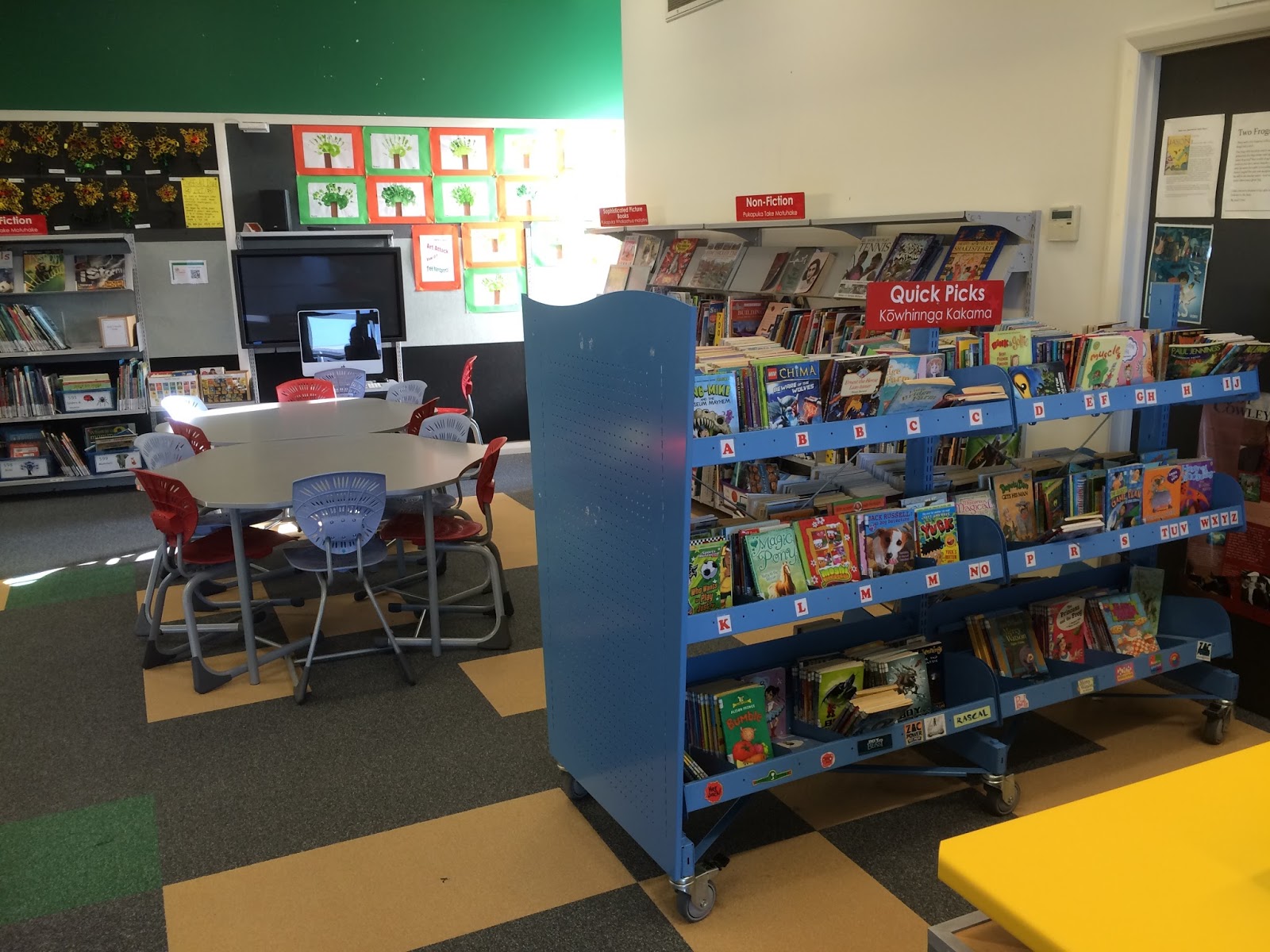
The 'Quick Picks' shelving on the right holds our early chapter books.  The bottom row and whole other side are organised by series, so students can quickly find their favourite books.  Behind this is our non-fiction area.  Currently some valuable shelving space on the far wall is covered by a TV that I use when I teach library skills.  In front of that is the OPAC, on another computer I managed to 'find' within the school.  Hopefully, if I have any money left over from our courtyard project, I will move the TV to a higher space above the shelving and use a couple of iPads for our OPACs. 


Tucked away in the far right of the non-fiction section is a cosy spot for students to sit.  In the far left is another pile of cushions and bean bags.


This is my outdoor courtyard area which has been enclosed with a plastic screen this month to weatherproof it.  The birds were also getting in and leaving their mark on the concrete, making it a less than appealing space to our students.  Given that the library is small for a school that by the end of the year has more than 800 students, I was keen to make full use of all the spaces available to me.  Fortunately I have a great Board of Trustees who approved funding to improve this area this year.

The tiered seating has been stained since this photo was taken and it will be covered in large cushions.  The other walls (in corrugated iron), and the glass doors, are in the process of being covered with a mural, which will extend round to the wood (it will have ivy painted on it).  Due to the painting in progress the area is currently out-of-bounds to students; I am so excited that we will soon have a new space to share with them.  I have lots of plans for it!


This is my office, which looks out into the library so I can keep an eye on what our classes are up to!  To be honest, this is the tidy version - I am usually fighting a losing battle with more paper that sits on my desk.


The other side of my office gets used by Esther, our awesome library assistant, for storage of books for processing.  I have put my library diploma and an award from SLANZA on the wall because people often don't believe that librarianship is a profession you can study for.  One way we can help change that attitude is to do little things like this.


I have read a number of studies showing that in any kind of library one of the most important things to patrons is seating.  I am pleased that we have such a big range of places for our students to sit.  At lunchtimes the library is usually full with students reading, using iPads and playing chess.  It is not the quiet libraries that I was brought up with but it does have a wonderful, vibrant buzz about it that makes students feel welcome.

Friday, 26 February 2016

Photographic Tour of School Libraries

Late last year I took part in a SLANZA Waikato/BOP tour of four amazing primary and intermediate school libraries in Auckland.  I'm going to share a few photos from each of the libraries with you.

First up was Fran Mes' library at Viscount School in Mangere.  Fran is the Director of Learning, Library and has been featured in an Excellence in Practice video by the National Library.  She teaches information literacy skills in the library and she shared this awesome House Hippo video as a way to show children that they can't believe everything they see on TV.  Fran is a strong believer in not having a library timetable. 


This is one of two pianos!


An amazing student-made mural


Train tracks, great for collaboration


Fish!


Next up was Esther Casey's library at Stonefields School, one of two libraries she manages.  Stonefields opened in 2011 and has 'open modern learning environments'.  I love the way Esther encourages her student authors and uses her library's website as a way to share their work.  Esther's takeaway for us was to remember to link our library goals with the school charter.  


On my 'to do' list


A nice range of seating to choose from


Esther in front of her flag display


What a great way to build connections with parents


I love these little slices of history


After lunch we visited the Library/Makerspace at Sunnyhills Primary School.  We met Helen, the Teacher with Library Responsibility, who was based in the library.  Helen worked closely with classroom teachers and tied her 'making' activities, like Scratch, into the classroom programme.  Her Lego walls helped teach symmetry and spatial awareness.  She felt that using a 3D printer should be more about the process than the product.  She had students make their designs in Lego first, before going on to use the 3D printer.


Tote trays contain supplies and are also used to store partially completed student work


The table on the left was set up with MaKey MaKey


3D Printer (bought from Office Max)


Lego Walls


Our final visit was the spectacular Somerville Intermediate.  It was built in the days when they gave libraries a decent amount of floor space, there were a lot of jealous librarians!  I got a shock when I recognised Annemarie, the librarian, who went to the same college as me!  Annemarie has different activities on each day - Cozy Corners, Kids' Lit Quiz Team, School Newspaper, Book Club and Groovy Game Day.


Annemarie in front of a list of her library activities


Love this advertising


A foreign language collection


Plenty of games


An OPAC on an iPad


There were two TVs outside showing slideshows

One bonus photo just to show you the amazing "street" that the architects designed for Somerville Intermediate.  The classes and the library line up on each side of the street.


Saturday, 6 February 2016

The Pros and Cons of Moderating a Slow Twitter Chat

This week I moderated our first #LibChatNZ slow Twitter chat.  After reading this blog post I asked Craig Kemp for some more information.


We decided it was worth giving it a go, and here's what I thought about it:

Pros

  • The format allows for a considered response to be posted at the most convenient time for the participant.
  • The speed of the chat is more user-friendly for new Twitter users, as opposed to the high-speed one hour chat version.
  • There is enough time to consider all the responses and reply to most of them.  A conversation about a particular comment can take as long as required and not feel rushed by the fact that a new question has just been asked.
  • It allows for an extended consideration of one question.

Cons
  • It is hard for participants to remember to contribute every day for a week, but if you are constantly reminding people that it's on it feels like you're nagging!
  • You lose the momentum that comes from having everyone contributing at the same time.  People can post when no-one else is online so opportunities for conversation can be missed.
  • Moderating takes a whole week!
  • The questions used need to be meaty enough to generate a whole day's discussion.  This takes out the smaller, introductory questions that you might use to build up momentum with a traditional Twitter chat.

Our chat this week was also badly timed as it was the first week back to school for many of us.  That makes it hard to know whether it was the timing or the format that reduced the amount of participants...probably both!  

If you are moderating a smaller slow chat I would recommend using ifttt.com and adapting a recipe that allows you to get sent an email every time that someone uses your hashtag.  I hadn't used the site before but it was relatively easy to do.  And you can turn it off once you are finished.

I think that a slow chat might work nicely if you are trying to gather information and not necessarily needing to chat as much.  Or, if you have a large amount of participants who are going to be regularly contributing over the course of the week.  Otherwise, I prefer a traditional one hour chat where you can interact immediately with others and it feels more vibrant and energetic.

Have you taken part in a slow chat?  What did you think about it?

Saturday, 30 January 2016

Exciting Projects for 2016!

I have had a restful and relaxing break so far and am now recharged and ready to attack some exciting projects this year.  This will be the third year I have blogged about my work plans for the year ahead - I find it a good way to focus in on the major things I want to achieve.  This year my post coincides with the first 2016 EdBlogNZ Challenge so I will take that as a sign I should join in!  Here's what I hope to be up to this year:

  • Library expansion!  FINALLY this is really happening.  Our courtyard area is going to be enclosed with an outdoor screen to make it weatherproof.  We've already had some awesome tiered seating put in and had the roof painted sky blue.  Jenna, our fantastic artist, has an awesome mural planned.  Plus I've convinced her to channel her inner Michelangelo and paint clouds on the ceiling.  After the mural the carpet will go in and then we will have a much-needed extra space for our students.

The BEFORE photo

  • Makerspace.  This is the year I hope to implement a Makerspace programme.  In addition to lending Maker Kits, I'd like to use our extra space for a weekly 'making' activity, put up weekly challenges, and encourage student, teacher and community involvement (permission pending!). 
  • Facebook.  Last year I wrote a post on 'Advocacy through Photojournalism'.  It was about gaining support for the library from the community, by posting photos of children with quotes from them about reading and the library.  This is the year I'll start my 'Stories from the Library' album.
  • Programming/Robotics Club.  I hope to run a programming/robotics club this year.  I wouldn't consider myself an expert but I am keen to learn along with our students.  
  • eBooks.  I'll be focussing on getting the teachers onboard with these.  Earlier this week I stole a couple of minutes from their Teacher Only day to quote recent research and hand everyone their usernames and passwords.  I'll also be building up our eBook collection; I hope to work with reluctant readers to find the best books to entice them with.
  • Book Week.  After I attended Cathy Kennedy's session on book weeks at last year's SLANZA conference, I was keen to set a theme for our book week early and build up resources and ideas.  I'd like the theme "Spies and Detectives", which we could use to highlight the Mystery genre section in our library.  There are also lots of interesting activities around observing, creating codes, disguises etc that should be educational and lots of fun for our students. I haven't had a chance to run this past management yet though.
  • 'Community' committee.  This is a new school committee that I am involved with, aimed at building further links with our community.  I am particularly interested in our digital communication and getting our community participating in Makerspace activities.
  • Student Digital Leaders.  This is still up in the air but it's an exciting opportunity to build digital skills within the school.

In addition to these things I'll also be continuing to improve my book club, help with the Te Totara Times, run library skills sessions and promote the use of the book fridge.  Good thing I've rested up!

Saturday, 16 January 2016

My 5 Star Reads from 2015: Children's Non-Fiction

Here's the last in my series of reviews about the top books I read last year:


Emmanuel's Dream: The True Story of Emmanuel Ofosu Yeboah by Laurie Ann Thompson
This is an inspiring true story about a boy who was born with a disability in a country (Ghana) where many people considered him to be cursed.  He hopped to school, played soccer on crutches and eventually found a job to support his family.  He went on to cycle across Ghana in order to raise awareness about the treatment of people with disabilities.


If...:  A Mind-Bending New Way of Looking at Big Ideas and Numbers by David J. Smith
"Some things are so huge or so hold that it's hard to wrap your mind around them.  But what if we took these big, hard-to-imagine objects and events, and compared them to things we can see, feel and touch?  Instantly we'd see our world in a whole new way."  

An excellent way for children to understand difficult concepts; the illustrations are also superb.


Handle with Care: An Unusual Butterfly Journey by Loree Griffin Burns
This is a beautifully photographed book showing how butterflies are sent to museums and butterfly houses around the world (I'd never thought about how they got them!).  In the process of finding out about of a butterfly farm in Costa Rica, students also learn about life cycles.  This is a fascinating book that belongs in every primary school library.


Once Upon a Slime by Andy Griffiths
I'd been dipping into this book for a while but 2015 was the year I actually read it cover to cover.  As promised on the cover it has some fun ways to get writing and I used several of these when I started my Ninja Readers and Storytellers' Club last year.  If your students enjoy Andy Griffiths' books as much as ours do (like his latest, The 65-Storey Treehouse), then this should be in your library too.


Manfish: A Story of Jacques Cousteau by Jennifer Berne
This is a really interesting biography of the life of Jacques Cousteau, written in a way that makes it accessible for young readers.


The Right Word: Roget and his Thesaurus by Jennifer Fisher Bryant
A book about a guy who made a thesaurus...I did not think this would be as amazing as it was!  A fascinating account of Roget's life accompanied by gorgeous illustrations.


Nelson Mandela by Kadir Nelson
The last of the four picture book biographies on this list.  I certainly had a great time reading about the interesting lives of people last year.  The illustrations in this book are gorgeous, as you can tell from the stunning cover.  The story is a concise account of Mandela's life that covers the key events in his life.  A great way to introduce students to this influential man.


Greek Mythology (Junior Genius Guides) by Ken Jennings
This is an engaging book that recounts Greek myths in a fun way.  A good non-fiction accompaniment to the Percy Jackson series.


Professional Reading

Like last year, I feel I must include one book that was great for me professionally.  Just like 'Once Upon a Slime' I had browsed this book prior to last year but 2015 was the year I read it all.


Teach Like a Pirate: Increase Student Engagement, Boost Your Creativity, and Transform Your Life as an Educator by Dave Burgess
Last year, I began teaching library skills and I wanted to make my sessions as interesting and memorable as possible.  This book has so many great ideas in it, it is positively inspiring!  There is bound to be something in there that you hadn't thought of doing.  It is a great way to bring variety to anything you are involved with - I also used it to get ideas for my book clubs.